Last week, the National Journal ran the latest in a series of pieces from a number of different outlets listing the Mountain State as the most depressed, least happy, generally completely bummed out state in America.
Some of this comes from the general problems West Virginia shares with many areas. Unemployment, uncertainty about the future, a federal government contriving night and day to zap productive coal mines and farms from existence.
But others come from cultural misunderstandings. Lifestyle choices, such as eating, drinking, and smoking, have little to do with actual happiness. Yet physical health is factored into "happiness" analysis. It is just as likely, if not more so, that West Virginians and others are not as hung up on obesity as those who live in the suburbs and write for National Journal. West Virginians have a healthier and more realistic appraisal of body image and a lot of other things.
Cultural differences matter. Appraising happiness in every state by the same criteria is a basic flaw in every such study. Like when Vermont researchers concluded Texans are the least happy because they swear a lot in social media. More often, the Texan is unhappy if he is not swearing.
Anyway, some reasons why West Virginia is the happiest state.
Centennial Golden Trout
The streets are not paved with gold. You can't even dig it out of the ground. But you can catch a real live slice of gold, or several other tasty species of fish, from most of the state's beautiful streams.
Make a Joyful Noise . . .
Almost every town of any size has a festival between March and November. Pictured here is some joyful noise being made at the Augusta festival in Elkins. One can also get joyful food, joyfully noisy parades, joyful boat races, joyful buckwheat cakes, and joyful crafts at one or more of these fun community get togethers.
. . . and, of course, patriotic
West Virginia has the largest small town 4th of July celebration in the world centered in Ripley. It stands to reason that the Mountain State loves America. It sends more men and women per capita into the U. S. armed forces than any other state.
Safe
West Virginia's near nationally low levels of property and violent crime co exist with near nationally high levels of gun ownership. Hmmmmmm.
Foooooooooooood!
West Virginia usually tops out lists of least healthy eaters, most overweight people. That is not indicative of happiness outside of narrow classes of people who fret about their weight. No study has been done, but West Virginians have a different ideal of body image and physical attractiveness than those who make up these studies. Mountain State women tend to prefer bigger men and men prefer curvier women.
Look at the culture. Cultural influences of West Virginia come from the American frontier, as well as German and Italian peasants. Without stacks of cash lying about to pay for more refined diversions, most people entertained themselves and others with food. Frontier people, Germans, and Italians know, if nothing else, how to turn a little into a lot. Those cultural ideals of entertainment and hospitality have come down to the 21st century.
And, finally, West Virginia makes some of the best victuals around. Charleston and its suburbs are a breakfast mecca, sporting Tudor's and Shoney's. Northern West Virginia and Keyser's Italian fare rivals any city in the nation for taste and beats nearly all for affordability.
This is why country people don't always eat right or look like stick figures.
The boys of fall (and winter, spring, and summer!)
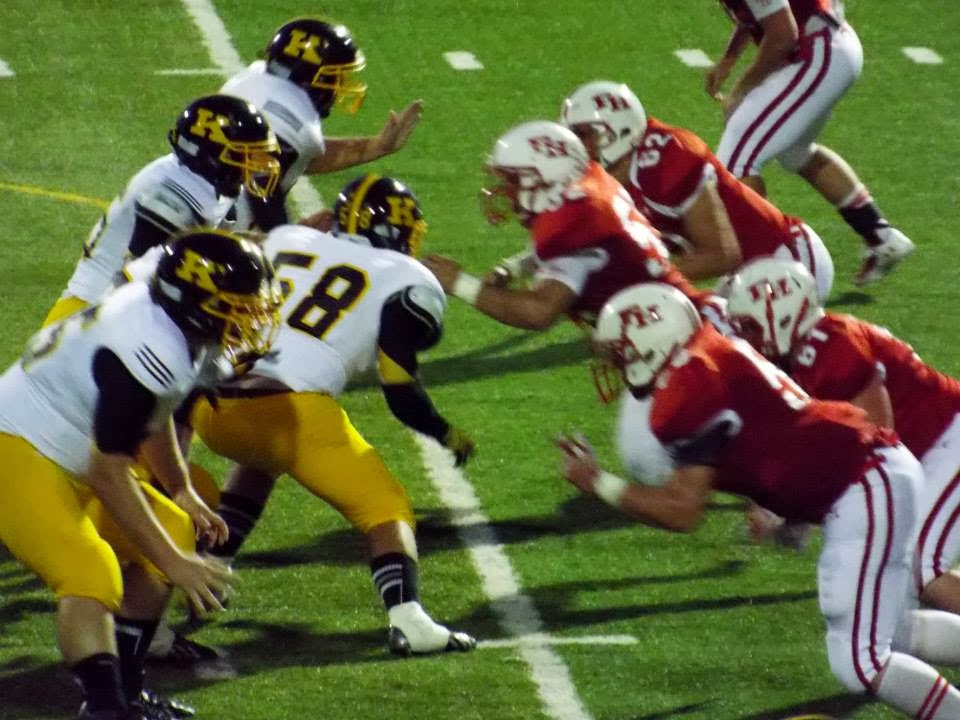
Everything from pee wee football and T ball to major college football at two ends of the state. Winning makes us happy. Even in losses, we can be proud of their hard work and effort.
Water, water, everywhere . . .
Most people love to be on the water. Fishing, swimming, sitting on a boat, running a jet ski way too fast. Everyone loves something a little different about the water. In West Virginia, unless you want salt water, you're in luck. Rushing shallow rivers, placid lakes, rivers long and deep enough for afternoon cruises, the Mountain State can make any fresh water aficionado happy!
History class is open
No one claims to like history class, but most people love history in some way. West Virginia has historical sites that are entertaining and informative. Above is Harpers Ferry, set in the drop dead beautiful confluence of the Potomac and Shenandoah rivers. Everything in town, except automobiles, electric, and the US 340 bridge, looks like it did in 1859 when John Brown launched his raid. The state also has museums, cultural centers, replicas of forts built over 200 years ago and more.
And this
Inside and out, one of the most beautiful buildings you will ever see, Forget the shenanigans that happen inside of it for a moment and consider just what a marvel it is.
And finally this little guy
He is wondering why anyone would think that a state that he represents would be the most bummed out.
Monday, February 24, 2014
Disagree With Democrats? Keep It to Yourself . . .Or Else
Since the election of Obama, liberals have gone after their political dissenters. First came White House attempts, fended off by the media, to declare Fox News a non news outlet, banishing them from the press corps. Then came years of the left's near fetish level fascination with "sedition." Tea Parties, Republicans, libertarians, nearly everyone associated with opposing this president gets tarred with the word. "Sedition" is the idea that speech that disrupts government functions should be criminal. Twice in American history have sedition laws been passed, both during wars with Great Powers.
The scandal over improper IRS harassment of groups opposed to the current federal government will not subside, despite the administration's best efforts.
Worst of all, last fall, a Washington Times reporter uncovering problems with the air marshal service had her research materials illegally seized by the Maryland State Police and turned over to the Department of Homeland Security.
Last week brought more stories of liberals and left wing attempts to chill speech or silence opponents.
Public outcry forced the Federal Communications Commission to back off of a plan to send monitors into broadcast and print media newsrooms to ask "invasive" questions about story selection and coverage. The FCC is mandated to regularly submit reports about potential barriers to small operators and entrepreneurship. Its questionnaire included many questions about journalism decisions, which could have a chilling effect on issue coverage. Many experts agree this violates the First Amendment, at least in spirit.
And finally on the state level, as West Virginia Metro News's Hoppy Kercheval puts it, some Democrats "can't stand a feisty Republican." West Virginia's elected Republican attorney general, Patrick Morrisey, faces the possible stripping of his constitutionally mandated powers. Like others, his "crime" seems to be strenuous opposition to the efforts and plans of the Obama Administration. Morrisey has been an outspoken opponent of infringements on the Second Amendment and EPA attacks on coal and power.
House Republicans and others noted that the state constitution and recent case law forbid the state legislature from doing precisely what House Democrats are trying.
The pattern is pretty clear. Speak out against Obama, oppose his administration's plans, and his allies try to bring the power of government down against you, usually illegally. Why can't America have bipartisan discussions and compromises? Partly because of this dynamic.
The scandal over improper IRS harassment of groups opposed to the current federal government will not subside, despite the administration's best efforts.
Worst of all, last fall, a Washington Times reporter uncovering problems with the air marshal service had her research materials illegally seized by the Maryland State Police and turned over to the Department of Homeland Security.
Last week brought more stories of liberals and left wing attempts to chill speech or silence opponents.
Public outcry forced the Federal Communications Commission to back off of a plan to send monitors into broadcast and print media newsrooms to ask "invasive" questions about story selection and coverage. The FCC is mandated to regularly submit reports about potential barriers to small operators and entrepreneurship. Its questionnaire included many questions about journalism decisions, which could have a chilling effect on issue coverage. Many experts agree this violates the First Amendment, at least in spirit.
And finally on the state level, as West Virginia Metro News's Hoppy Kercheval puts it, some Democrats "can't stand a feisty Republican." West Virginia's elected Republican attorney general, Patrick Morrisey, faces the possible stripping of his constitutionally mandated powers. Like others, his "crime" seems to be strenuous opposition to the efforts and plans of the Obama Administration. Morrisey has been an outspoken opponent of infringements on the Second Amendment and EPA attacks on coal and power.
House Republicans and others noted that the state constitution and recent case law forbid the state legislature from doing precisely what House Democrats are trying.
The pattern is pretty clear. Speak out against Obama, oppose his administration's plans, and his allies try to bring the power of government down against you, usually illegally. Why can't America have bipartisan discussions and compromises? Partly because of this dynamic.
Labels:
Hoppy Kercheval,
IRS scandal,
MSNBC,
Patrick Morrisey,
sedition,
Washington Times
Friday, February 21, 2014
If Michael Sam Can Play, He Will Play. But Where?
It was supposed to be the Johnny Manziel Show, but the talk of this year's NFL Draft will center around openly gay University of Missouri pass rushing specialist Michael Sam. His carefully prepared rollout of a public acknowledgment included placed stories in choice outlets designed to spark questions and, most of all, buzz. Questions and speculation runs the spectrum from where will he be drafted to whether he will be accepted.
First of all, plain and simple, if Michael Sam has NFL talent, he will get an opportunity.
At 6'2, weighing 255, his height could be an issue. Ideally, NFL squads like pass rushers with more length than Sam offers. He, however, excelled in the Southeastern Conference against NFL ready linemen. If anyone had any questions about whether or not he has NFL talent, this fact alone answers it.
The bigger question is if he will be accepted in an NFL locker room. Also, how will his team handle the blistering press attention? Some compare his possible entrance to Jackie Robinson, others see loose similarities with Tim Tebow and even Manti Teo.
Former NFL linebacker Lavar Arrington on his drive time show in Washington DC's WJFK insisted that Sam faced many of the same pressures and potentially much of the same hostility as Robinson. The most vulgar in opposing fanbases will never let him forget his sexuality. Then again, you also have the viral video of a Jets fan from last season screaming for his own team's quarterback to tear his ACL. Fans will be fans. Sam will get the taunts, no doubt. Certainly they will sting in a way that no one outside of his situation could imagine.
No one can predict how a specific locker room might react, but certainly executives do fear the scrutiny and potential issues.
That is why Sam will likely be drafted lower than he should, but will most likely end up with a winning organization.
Winning organizations generally forbid chaotic locker rooms. Witness the report on the hapless Miami Dolphins that described continual meltdown over several years. Remember how Tim Tebow, personally the least offensive player one can imagine, polarized the locker room of the New York Jets. Extra attention for non football attributes can rub people the wrong way, particularly on a losing team. No matter whether the player is gay, an evangelical Christian, or a famed balloon artist, there will be jealousy.
Winning organizations establish professionalism. Players and coaches do not become automatons, but they do have a clear understanding of what they can and cannot do or say. They want to stay with a winner, so they conduct themselves accordingly. So Sam will likely end up playing for one of those well-established winners like the New England Patriots, Pittsburgh Steelers, or San Francisco 49ers. Winning stems from a professional attitude established at the top. They also specialize in handling the press and putting public attention in its proper place.
And that would be the best possible outcome. On a team like the Steelers or the Patriots, Sam simply becomes a player doing his job. That was certainly not his intention when his people orchestrated his announcement, but that would be the best result for both Sam and whatever team drafts him moving forward.
First of all, plain and simple, if Michael Sam has NFL talent, he will get an opportunity.
At 6'2, weighing 255, his height could be an issue. Ideally, NFL squads like pass rushers with more length than Sam offers. He, however, excelled in the Southeastern Conference against NFL ready linemen. If anyone had any questions about whether or not he has NFL talent, this fact alone answers it.
The bigger question is if he will be accepted in an NFL locker room. Also, how will his team handle the blistering press attention? Some compare his possible entrance to Jackie Robinson, others see loose similarities with Tim Tebow and even Manti Teo.
Former NFL linebacker Lavar Arrington on his drive time show in Washington DC's WJFK insisted that Sam faced many of the same pressures and potentially much of the same hostility as Robinson. The most vulgar in opposing fanbases will never let him forget his sexuality. Then again, you also have the viral video of a Jets fan from last season screaming for his own team's quarterback to tear his ACL. Fans will be fans. Sam will get the taunts, no doubt. Certainly they will sting in a way that no one outside of his situation could imagine.
No one can predict how a specific locker room might react, but certainly executives do fear the scrutiny and potential issues.
That is why Sam will likely be drafted lower than he should, but will most likely end up with a winning organization.
Winning organizations generally forbid chaotic locker rooms. Witness the report on the hapless Miami Dolphins that described continual meltdown over several years. Remember how Tim Tebow, personally the least offensive player one can imagine, polarized the locker room of the New York Jets. Extra attention for non football attributes can rub people the wrong way, particularly on a losing team. No matter whether the player is gay, an evangelical Christian, or a famed balloon artist, there will be jealousy.
Winning organizations establish professionalism. Players and coaches do not become automatons, but they do have a clear understanding of what they can and cannot do or say. They want to stay with a winner, so they conduct themselves accordingly. So Sam will likely end up playing for one of those well-established winners like the New England Patriots, Pittsburgh Steelers, or San Francisco 49ers. Winning stems from a professional attitude established at the top. They also specialize in handling the press and putting public attention in its proper place.
And that would be the best possible outcome. On a team like the Steelers or the Patriots, Sam simply becomes a player doing his job. That was certainly not his intention when his people orchestrated his announcement, but that would be the best result for both Sam and whatever team drafts him moving forward.
Wednesday, February 19, 2014
Management Cannot Be Incognito When Employees Act Unprofessionally
For most of the last 40 years, the Miami Dolphins served as the southern flagship of the National Football League. Captained by Don Shula, steered by greats such as Larry Csonka and Dan Marino, the organization exuded class and success.
Those days are well past this franchise. Now the private world of its locker room over the last several years is laid bare. All the dysfunction and bizarre behavior exposed.
The initial string on the unraveled sweater comes from former offensive line starter Jonathan Martin. He complained of a difficult working environment full of taunts, harassment, and bullying. Some of it came his way, much of it was back and forth between others. Martin left the team abruptly, then claimed harassment at the hands of teammate and fellow starting lineman Richie Incognito.
But the story didn't add up. Teammates generally supported Incognito, even after the team released him. Incognito released hundreds of texts sent between the two men. As a whole, they paint a picture of two guys whose talk about women and life in general sound like sailors on perpetual leave more than bullying.
Martin also revealed that he suffered from severe depression and had been hospitalized in a mental institution. Incognito was one of the teammates texting to support Martin. Hardly the stuff of bullying.
The problem with the coverage of this story is that the media takes Martin's word at face value. Anyone suffering from clinical depression and bipolar disorder does not see the world as it is. They have a skewed perspective of the people around them and can see slights and offenses where none were taken. Much like Montressor dwelling on the "thousand injuries" of the good time Charlie Fortunato, Martin likely saw himself as a target when he was not.
Proof of this lies in Martin's actual position. Incognito did not bestride his narrow world as a Colossus. These men are about the same size. Both started on the offensive line. Incognito had no real power or leverage over Martin. Martin did not recognize that he is master of his own fate. It was not in his stars, but the mental illness that gripped him that made him feel like an underling.
That is not to say that bullying did not happen in that locker room or that Incognito was a pure saint. He is guilty of taking part in taunting and pranking that did, in retrospect, perhaps hold the team back from developing.
Some responsibility lies on the shoulders of Martin. Some lies on Incognito and other players who took part.
But most lies squarely on the organization. Organizational culture must be established at the top. That comes from clear expectations of professionalism by everyone from the owner down to the popcorn seller. This doesn't mean that players have to act like they are in a golly gee whiz 1950s movie, or like automatons. But they have to understand that they represent an organization and a team mission. That they are expected to conduct themselves in the locker room and on the field as if the whole world were always watching. Which, increasingly, it is.
Some jobs will never be Oprahfied, turned into bastions of caring sensitivity. The National Football League will have little problem accepting openly gay players, but it will always be relentless on those lacking mental toughness. Martin had problems that likely would keep him from succeeding anywhere in the NFL. The constant competition, scrutiny, and pressure fold, spindle, and mutilate some people. And he is far from the only one who could not handle the rigors of NFL life. Pittsburgh's Kordell Stewart had every physical gift to make him a starting quarterback, but could not handle the pressure when losses piled up. He was a great athlete and a good person, but lacked the mentality necessary to remain in his job.
Some will argue that it's just a game. But it is also a product that earns millions for participants and billions for teams. Fair or not, pressure comes with the position.
Organizations like the Steelers, Patriots, and others expect professionalism and subordinate everything to winning. The Steelers' ownership quickly ships out those who undermine the locker room. Bill Belichick expects a disciplined team. His coaches even call out quarterback Tom Brady when they feel he has abused his receivers too much.
Incognito will play next year. Martin likely will not. Incognito's problems do not stem from the fact, as many in the media have claimed, that he is a "meathead." His manner of expression and his behavior are not those of a particularly smart guy, but no one lasts long in the NFL without some smarts. The best of all possible worlds for him is a team like the Steelers. They need line help desperately, but are a strong enough organization to dampen any negative buzz around his acquisition. He would likely thrive in an organization with a disciplined and winning mindset.
Plus, after the pat year, once with another team Incognito will behave like a sinner in the hands of an angry God. Remorseful or not, he has one chance left in him and he knows it. The whole world is watching and he is now aware.
For Martin to play again, he would have to prove that he has healed and matured. One can easily prove recovery from a knee injury. Scars from mental issues are more problematic.
As for the Dolphins, they are in the same boat as anyone else whose deepest dysfunction just went public. Organizational chaos bred many of the problems they face right now, including chronic losing.
Incognito and Martin only revealed the deeper issues. An executive left the team months ago, claiming he had been shoved out. The head trainer, a coach and players relentlessly harassed an assistant trainer, implying he was homosexual. A lot has to change in the organization, not just a Band Aid, but a cultural overhaul.
The Dolphins took years to reach this stage. Turning around will not happen overnight. But for them to earn respect again, the Dolphins must take the first step on a tough journey.
Labels:
Jonathan Martin,
Miami Dolphins,
Richie Incognito
Monday, February 17, 2014
Ten Interesting Presidents
Not the best ten. Just ten interesting holders of the highest office in the land.
The American presidency has always had an allure unique among worldwide offices. It grants many of the powers assumed by Augustus, first emperor of Rome. The caveat is that office holders have a relatively short time to govern and that they must be chosen.
George Washington
Not just the greatest President. Not just the greatest American. Truly one of the great figures in world history. Without his calls to action and leadership, the American Revolution likely dissolves into a society of complainers and philosophy students. Guided the Constitutional Convention, often with glances instead of words. Defined what a president should be and how one should act.
Those who downgrade his accomplishments forget that he had to also establish international respect for America's territorial integrity and national credit during a world war.
Not placing Washington in the top spot as president is sheer trolling.
Washington believed strongly in the dignity of office, even among close friends as Governeur Morris found to his embarrassment. His belief in republican simplicity extended to wearing black suits instead of military dress and forbidding music or announcements when he entered a room. If a president deserves respect and attention, he will get it without the extra fuss.
John Adams
Obviously not a digital photo of the real John Adams. This is Paul Giamatti from the outstanding HBO miniseries based on the outstanding David McCullough book.
Modern students of history love John Adams. We all know someone like Adams. Or maybe some of us are this guy. Brilliant beyond measure. But also jealous (rightfully) of not getting the credit he deserves. Often grumpy and cynical (these traits usually soothed, but also occasionally stoked by his also brilliant wife Abigail. And held legendary grudges against Alexander Hamilton, Thomas Jefferson and others.
Adams just didn't fit in. Not on his diplomatic missions to North Africa, Britain, and elsewhere; not with the intellectual set at the Constitutional Convention; not with men of action like Washington.
But without his intellect, work, and guidance, our Republic may not be here. His 20 hour days keeping things together at the Continental Congress built the nation. His presidency is remembered more for its foolish acceptance of bad laws than its creation of the United States Navy and successful fight against France.
The second president proves that social awkwardness and unchained, stubborn, untactful brilliance can succeed somewhere besides social media. Then again, in our time, Adams may never have been able to break free of Facebook argument.
By the way, Adams owes David McCullough big time.
Andrew Jackson
Jackson needs more attention. It is tempting to judge him directly on a single action, the Cherokee removal. Here, Jackson violated property rights and federal law to assist gold prospectors (basically the kind of crony capitalism that happens regularly in Washington today.)
That being said, Jackson represented a new democracy that in many ways diametrically opposed his removal of the Cherokees from their home. He stood for property rights, individual freedom, limited government, and workable state sovereignty. For the first time, the West had a voice in government through the figure of the backwoods warlord. William Henry Harrison, James Polk and Lincoln would follow after.
Jackson's impact on the Democratic Party lasted longer. Mistrust of big business and big government alike permeated the Southern backwoods. Belief that the Democratic Party represented these values only died in the last generation.
James K. Polk
Polk was neo-con when neo-con wasn't cool. This surprisingly Mel Gibson looking president represented the Democratic Party's return to running backwoodsmen who could pass as commoners (after the one term of New York businessman Martin van Buren.) Polk stood for election on annexing Texas and Oregon. As it turns out, most of the nation agreed. As did Texas and the region of Oregon Territory ultimately added to the Union.
Polk gets blamed for the Mexican War. Historians cite both Ulysses S. Grant and Robert E. Lee as sources blaming land greed for a war they deemed wrong. Grant and Lee were also both in the Whig Party, which could give some context to their opposition.
Fact is that Polk may have wanted a war with Mexico. But he did not want war worse than the Mexicans themselves. Mexico picked fights repeatedly during the mid 1800s and lost all of them, including (I kid you not) the Pastry War with France. The Mexicans refused Polk's offer to pay for Texas annexation, which was completely unnecessary under international law. They declared war. If Polk had set a trap, Mexico walked into it.
Polk's handling of the Mexican War should have blown up in his face. He removed Zachary Taylor from command out of fears that the general would grow too popular and become president, a correct prediction. But Mexico, under the leadership of Antonio Lopez de Santa Anna, lacked the organization and the economic strength behind the American forces.
Polk promised to serve one term. He kept his promise. That alone is worth remembering.
No Lincoln here
The most written about man in human history, which would have surprised him. No need to write more.
Ulysses S. Grant
This is how America should remember Grant. Grant's most well-known Civil War era picture shows the 21st century what swagger truly is. Against his enemies both in the Confederacy and in the Union Army itself, Grant applied slow, steady, relentless pressure. He used Northern economic and population superiority to wear down the South, while relying on Lincoln's support against military command rivals.
But America remembers the image that goes along with fifty dollar bill Grant. Rounder face, protruding stomach tightening his suit. History associates this Grant with his poor choices of friends and officeholders, many of whom betrayed him and the public trust.
Grant, however, earned his enemies while president by doing the right things as well. He aggressively used the power of the new Department of Justice and the military to stamp out Ku Klux Klan terrorism. Grant worked to treat Indians as humanely and respectfully as possible, blaming much of the friction on settler troublemakers. These grew unpopular as Reconstruction lasted 12 years longer than the Civil War itself and as political officeholders found themselves booted from Indian Affairs jobs.
He also lost support during one of the worst depressions in American history. Grant and the Republican Congress strengthened the dollar and did little else. The economy bounced back in four years, as opposed to much longer stretches under Franklin Roosevelt and Barack Obama. All of these unpopular moves required courage in the face of certain declines in popularity.
Grant was a great general. He was also one of the great autobiographers in history. But his virtues as a military man and a writer failed to serve him as a president or a businessman.
Rutherford B. Hayes
At the time of his nomination in 1876, Hayes had earned the description of "the good gray governor." This came from a lifetime of being quietly competent and just.
Hayes' Civil War service started in the backwoods of western Virginia. He was among the first to encounter the rise of guerrilla fighting as he marched his columns through narrow valleys. Despite the frustrations, Hayes rarely let the situation get the better of him. He upbraided a subordinate for the punitive burning of a courthouse. Toward the end of the war, Hayes escaped the raid that captured two other Union generals. He, Washingtonlike, shared the discomforts of his men by camping with them in frigid February 1865. the other two stayed in a lavish hotel with few guards.
Reconstruction ended in 1877 as part of the deal bringing Hayes to office. The razor thin margins threatened to unleash another Civil War. Neither side particularly supported the quid pro quo and its contribution to the long term establishment of Jim Crow is undeniable.
So why is Hayes "interesting?" Because he and his wife "Lemonade Lucy" (named so because she did not allow alcohol in the White House) may be the most boring of First Families. Hayes lived quietly, administered the government, did not seek attention, and stepped aside after one term. Like his military career, his presidency was quiet, effective, competent, and forgettable due to its success. No one ever writes about cruise ship captains who never wreck. And few are interested in a president so lacking in the dazzling show that the office has become.
And that is precisely why he is worth remembering.
William McKinley
Last of the Civil War officer presidents. McKinley, like Garfield, Harrison, and Hayes all served in the West Virginia, Virginia, Kentucky theater of war.
McKinley ushered in a generation of Republican Party dominance and straddled eras. He was the last front porch campaigner who sat at home in the traditional way and let subordinates do all the work. But his campaign started the use of mailed campaign literature. Historians lump him with the 19th century presidents, but his annexation of the Philippines marked the United States' entry into international affairs.
McKinley fails to make the grade of "great presidents" in most academic lists. He, however, won a war against Spain that he personally tried to head off. Under McKinley the national economy boomed (albeit under anti-free market and probably unnecessary protective tariffs.)
It's hard to argue with success.
History's problem with McKinley is that he served right before Theodore Roosevelt, who was never supposed to be president. Had McKiney not died by an assassin's bullet, he likely would have been succeeded by another honest competent senator, West Virginia's Stephen Elkins who was seen as the next Republican option. McKinley was, however, assassinated by a terrorist and the polymath Roosevelt took office.
William Howard Taft
Taft, like Adams, has earned a spot in the hearts of historians (if not their rankings) because of his humanness next to a blue star of a predecessor.
He did not want to go to law school in the first place. His father, however, insisted that law school provided more of a future than catching for the Cincinnati Reds.
Taft worked well when working with someone else. Under Theodore Roosevelt, he solved problems across the globe, most notably in the Philippines where his conciliatory policies quelled a revolt.
He never wanted to be president. Mrs. Taft, however, had enough ambition for both of them. Jealous of the spotlight on her husband's friend Teddy, she allied with the president to badger Taft into a job he didn't want.
Roosevelt expected his friend to remain his cipher, following his policies to the letter. The lawyer Taft, however, made decisions based on rule of law, as opposed to the Roosevelt way of favoring friends and skewering enemies. This made an enemy out of Roosevelt who skewered Taft in the election of 1912, bringing an ignominious end to the political careers of both.
Taft got the last laugh, ending up with the job he coveted more than any other. Chief Justice of the United States Supreme Court, making him one of the most accomplished men in US history that few remember outside of a certain bathtub incident.
Calvin Coolidge
Less talk. Only acted when necessary. Country remained at peace. National economy boomed.
And he wore a dazzling array of cool hats.

The American presidency has always had an allure unique among worldwide offices. It grants many of the powers assumed by Augustus, first emperor of Rome. The caveat is that office holders have a relatively short time to govern and that they must be chosen.
George Washington
Not just the greatest President. Not just the greatest American. Truly one of the great figures in world history. Without his calls to action and leadership, the American Revolution likely dissolves into a society of complainers and philosophy students. Guided the Constitutional Convention, often with glances instead of words. Defined what a president should be and how one should act.
Those who downgrade his accomplishments forget that he had to also establish international respect for America's territorial integrity and national credit during a world war.
Not placing Washington in the top spot as president is sheer trolling.
Washington believed strongly in the dignity of office, even among close friends as Governeur Morris found to his embarrassment. His belief in republican simplicity extended to wearing black suits instead of military dress and forbidding music or announcements when he entered a room. If a president deserves respect and attention, he will get it without the extra fuss.
John Adams
Obviously not a digital photo of the real John Adams. This is Paul Giamatti from the outstanding HBO miniseries based on the outstanding David McCullough book.
Modern students of history love John Adams. We all know someone like Adams. Or maybe some of us are this guy. Brilliant beyond measure. But also jealous (rightfully) of not getting the credit he deserves. Often grumpy and cynical (these traits usually soothed, but also occasionally stoked by his also brilliant wife Abigail. And held legendary grudges against Alexander Hamilton, Thomas Jefferson and others.
Adams just didn't fit in. Not on his diplomatic missions to North Africa, Britain, and elsewhere; not with the intellectual set at the Constitutional Convention; not with men of action like Washington.
But without his intellect, work, and guidance, our Republic may not be here. His 20 hour days keeping things together at the Continental Congress built the nation. His presidency is remembered more for its foolish acceptance of bad laws than its creation of the United States Navy and successful fight against France.
The second president proves that social awkwardness and unchained, stubborn, untactful brilliance can succeed somewhere besides social media. Then again, in our time, Adams may never have been able to break free of Facebook argument.
By the way, Adams owes David McCullough big time.
Andrew Jackson
Jackson needs more attention. It is tempting to judge him directly on a single action, the Cherokee removal. Here, Jackson violated property rights and federal law to assist gold prospectors (basically the kind of crony capitalism that happens regularly in Washington today.)
That being said, Jackson represented a new democracy that in many ways diametrically opposed his removal of the Cherokees from their home. He stood for property rights, individual freedom, limited government, and workable state sovereignty. For the first time, the West had a voice in government through the figure of the backwoods warlord. William Henry Harrison, James Polk and Lincoln would follow after.
Jackson's impact on the Democratic Party lasted longer. Mistrust of big business and big government alike permeated the Southern backwoods. Belief that the Democratic Party represented these values only died in the last generation.
James K. Polk
Polk was neo-con when neo-con wasn't cool. This surprisingly Mel Gibson looking president represented the Democratic Party's return to running backwoodsmen who could pass as commoners (after the one term of New York businessman Martin van Buren.) Polk stood for election on annexing Texas and Oregon. As it turns out, most of the nation agreed. As did Texas and the region of Oregon Territory ultimately added to the Union.
Polk gets blamed for the Mexican War. Historians cite both Ulysses S. Grant and Robert E. Lee as sources blaming land greed for a war they deemed wrong. Grant and Lee were also both in the Whig Party, which could give some context to their opposition.
Fact is that Polk may have wanted a war with Mexico. But he did not want war worse than the Mexicans themselves. Mexico picked fights repeatedly during the mid 1800s and lost all of them, including (I kid you not) the Pastry War with France. The Mexicans refused Polk's offer to pay for Texas annexation, which was completely unnecessary under international law. They declared war. If Polk had set a trap, Mexico walked into it.
Polk's handling of the Mexican War should have blown up in his face. He removed Zachary Taylor from command out of fears that the general would grow too popular and become president, a correct prediction. But Mexico, under the leadership of Antonio Lopez de Santa Anna, lacked the organization and the economic strength behind the American forces.
Polk promised to serve one term. He kept his promise. That alone is worth remembering.
No Lincoln here
The most written about man in human history, which would have surprised him. No need to write more.
Ulysses S. Grant
This is how America should remember Grant. Grant's most well-known Civil War era picture shows the 21st century what swagger truly is. Against his enemies both in the Confederacy and in the Union Army itself, Grant applied slow, steady, relentless pressure. He used Northern economic and population superiority to wear down the South, while relying on Lincoln's support against military command rivals.
But America remembers the image that goes along with fifty dollar bill Grant. Rounder face, protruding stomach tightening his suit. History associates this Grant with his poor choices of friends and officeholders, many of whom betrayed him and the public trust.
Grant, however, earned his enemies while president by doing the right things as well. He aggressively used the power of the new Department of Justice and the military to stamp out Ku Klux Klan terrorism. Grant worked to treat Indians as humanely and respectfully as possible, blaming much of the friction on settler troublemakers. These grew unpopular as Reconstruction lasted 12 years longer than the Civil War itself and as political officeholders found themselves booted from Indian Affairs jobs.
He also lost support during one of the worst depressions in American history. Grant and the Republican Congress strengthened the dollar and did little else. The economy bounced back in four years, as opposed to much longer stretches under Franklin Roosevelt and Barack Obama. All of these unpopular moves required courage in the face of certain declines in popularity.
Grant was a great general. He was also one of the great autobiographers in history. But his virtues as a military man and a writer failed to serve him as a president or a businessman.
Rutherford B. Hayes
At the time of his nomination in 1876, Hayes had earned the description of "the good gray governor." This came from a lifetime of being quietly competent and just.
Hayes' Civil War service started in the backwoods of western Virginia. He was among the first to encounter the rise of guerrilla fighting as he marched his columns through narrow valleys. Despite the frustrations, Hayes rarely let the situation get the better of him. He upbraided a subordinate for the punitive burning of a courthouse. Toward the end of the war, Hayes escaped the raid that captured two other Union generals. He, Washingtonlike, shared the discomforts of his men by camping with them in frigid February 1865. the other two stayed in a lavish hotel with few guards.
Reconstruction ended in 1877 as part of the deal bringing Hayes to office. The razor thin margins threatened to unleash another Civil War. Neither side particularly supported the quid pro quo and its contribution to the long term establishment of Jim Crow is undeniable.
So why is Hayes "interesting?" Because he and his wife "Lemonade Lucy" (named so because she did not allow alcohol in the White House) may be the most boring of First Families. Hayes lived quietly, administered the government, did not seek attention, and stepped aside after one term. Like his military career, his presidency was quiet, effective, competent, and forgettable due to its success. No one ever writes about cruise ship captains who never wreck. And few are interested in a president so lacking in the dazzling show that the office has become.
And that is precisely why he is worth remembering.
William McKinley
Last of the Civil War officer presidents. McKinley, like Garfield, Harrison, and Hayes all served in the West Virginia, Virginia, Kentucky theater of war.
McKinley ushered in a generation of Republican Party dominance and straddled eras. He was the last front porch campaigner who sat at home in the traditional way and let subordinates do all the work. But his campaign started the use of mailed campaign literature. Historians lump him with the 19th century presidents, but his annexation of the Philippines marked the United States' entry into international affairs.
McKinley fails to make the grade of "great presidents" in most academic lists. He, however, won a war against Spain that he personally tried to head off. Under McKinley the national economy boomed (albeit under anti-free market and probably unnecessary protective tariffs.)
It's hard to argue with success.
History's problem with McKinley is that he served right before Theodore Roosevelt, who was never supposed to be president. Had McKiney not died by an assassin's bullet, he likely would have been succeeded by another honest competent senator, West Virginia's Stephen Elkins who was seen as the next Republican option. McKinley was, however, assassinated by a terrorist and the polymath Roosevelt took office.
William Howard Taft
Taft, like Adams, has earned a spot in the hearts of historians (if not their rankings) because of his humanness next to a blue star of a predecessor.
He did not want to go to law school in the first place. His father, however, insisted that law school provided more of a future than catching for the Cincinnati Reds.
Taft worked well when working with someone else. Under Theodore Roosevelt, he solved problems across the globe, most notably in the Philippines where his conciliatory policies quelled a revolt.
He never wanted to be president. Mrs. Taft, however, had enough ambition for both of them. Jealous of the spotlight on her husband's friend Teddy, she allied with the president to badger Taft into a job he didn't want.
Roosevelt expected his friend to remain his cipher, following his policies to the letter. The lawyer Taft, however, made decisions based on rule of law, as opposed to the Roosevelt way of favoring friends and skewering enemies. This made an enemy out of Roosevelt who skewered Taft in the election of 1912, bringing an ignominious end to the political careers of both.
Taft got the last laugh, ending up with the job he coveted more than any other. Chief Justice of the United States Supreme Court, making him one of the most accomplished men in US history that few remember outside of a certain bathtub incident.
Calvin Coolidge
Less talk. Only acted when necessary. Country remained at peace. National economy boomed.
And he wore a dazzling array of cool hats.
Friday, February 14, 2014
Liberals, Conservatives Wary of Time Warner and Comcast Merger
What could bring conservatives and liberal-leftists to, if not arm in arm cooperation, at least shouting distance agreement? The impending merger between Time Warner and Comcast, the cable company currently ruling the NBC empire of networks.
Media Research Center's Newsbusters, a conservative media watchdog site, sounded the tocsin this week. It warned readers that the combination of two cable giants could bring competitive benefit to Comcast's prize NBC products. These would wield "even more influence."
Senator Al Franken, a former media figure in the employee of NBC during his years on Saturday Night Live, wrote to the Department of Justice, Federal Trade Commission, and Federal Communications Commission. Franken related his "serious reservations" about the merger. He went on to say " Unfortunately, a handful of cable companies dominate the market, leaving customers with little choice but to pay high bills for often unsatisfactory service."
Gizmodo related larger concerns. With cable dwindling, the size of the new conglomerate could control broadband access, since internet relies on the same wiring to get into the house. In the short term, a near monopoly in the cable market (Gizmodo compared it to Coca Cola buying Pepsi-Cola) could enforce bad deals on not only cable channels like The Weather Channel, but also the major networks. Fearing loss of market when television viewership as a whole is down, networks and channels could possibly be bent to the will of the new company much more easily.
Or this could be another case of Time Warner hitching itself to a fading star.
Back in what seems like a generation ago, there was once a company called AOL Time Warner. Time Warner endeavored to combine with the most prominent name in internet providers, raising fears of media monopoly. No one could speculate the impact of a single company across a spectrum of media. Certainly almost no one guessed that AOL was on the verge not of omnipotence, but irrelevance.
History may not repeat itself exactly in this case. But the history of monopolies in a free market shows a pattern. Monopolies, unless backed by government favor or power as in the example of the 1770s British East India company, are inherently unstable. They act sluggishly, only innovate slowly, and usually either shrink or break apart due to pressures from competition.
Monopolies rely on what worked in the past while ignoring the future. IBM was fated to lose technological dominance the day it ignored Bill Gates. Comcast's dominance of cable may be akin to a hypothetical carriage monopoly in 1900. They may win today and be a footnote tomorrow.
Advances in technology are the biggest enemy of monopoly and market dominance. Giant companies fear the change that smaller companies embrace and drive. The many technological alternatives to cable render fears of a monopoly moot. AT&T once dominated the long distance telephone market. Had Congress not broken AT&T up in the 1980s, the internet and cell phones would have undermined their market control. Time Warner itself struggles to figure out how to make sure profits on some of its traditional holdings.
After all, in the 21st century, Bleacher Report is worth more than the Washington Post. It's a new day.
Conservatives worry about the possible outsized influence on media and politics of their MSNBC nemesis. Liberals and leftists fear the old bogeyman of monopoly, this time in media form. At the end of the day, even if this merger goes through, history shows that there will be sound and fury. But market mechanics remain. Consumers will demand to be satisfied, or they will turn to satellite television, the internet, or some other source even more than they do now.
In the cable TV market, the cable companies do not rule the consumer. Increasingly, they will face the fact that they must serve the market or disappear.
Thursday, February 13, 2014
Politico Has Bad News For Rahall, Other House Candidates
"There is no question that Democratic donors are shifting toward the Senate in 2014," Democrat megadonor and Nancy Pelosi friend Joe Cotchett told Politico.
Democratic donors may likely chalk up the House of Representatives as unwinnable and concentrate on keeping the Senate in their hands.
With noted congressional prognosticator Larry Sabato now rating the WV 03 race a tossup, diminishing Democratic support could help cost Nick Rahall the seat he has held for decades.
Democratic donors may likely chalk up the House of Representatives as unwinnable and concentrate on keeping the Senate in their hands.
With noted congressional prognosticator Larry Sabato now rating the WV 03 race a tossup, diminishing Democratic support could help cost Nick Rahall the seat he has held for decades.
Labels:
#wv03,
Evan Jenkins,
Larry Sabato,
Nancy Pelosi,
Politico
Putting Communism's Stranglehold on Cuba In Perspective
More evidence that Marxism doesn't work.
In the past two years, Cuban president Raul Castro has introduced over 300 changes to the totalitarian command economy. These actions indicate that even the country's leadership knows that Communism is destructive to an economy and its people.
How destructive?
American Enterprise Institute released a state gross domestic product map. This map was unique in that it listed the country closest to each states output. Cuba's economy was closest to that of West Virginia.
The Mountain State ranked 49th in the nation in some measures of GDP in 2012, yet tremendously outperformed Cuba. West Virginia's 1.8 million people live in an area with less than half the land area of Cuba and less than 10 percent of the population.
Were Cuba a US state, a chasm would separate it from the per capita productivity of all other states.
Leftists avoid the issue of Fidel Castro's brutal treatment of political dissidents and Che Guavara's murderous terrorism, while praising selected parts of his system.
The current Cuban regime's moves mirror Vladimir Lenin's 1921 New Economic Policy. Lenin liberalized the Soviet Communist system just enough to keep it afloat, but did little to expand true opportunities for the industrious.
A free Cuba holds tremendous potential. Cuban refugees flourished in the American business community, particularly in Florida. Immigrants and their children have emerged as important leaders at the state and national level. Ted Cruz and Marco Rubio represent their constituents ably in the United States Senate. West Virginia's Alex Mooney may well succeed Shelley Moore Capito as 2nd District Representative should he win the GOP nomination there.
Certainly the same tradition that produced such success stories in the United States can revive under the warm sun of liberty, once it is restored to that country.
That means that Cuba should not be overly praised or rewarded for simply trying to keep their totalitarian system afloat with piecemeal changes. Only a full revolution of liberty deserves praise and support.
In the past two years, Cuban president Raul Castro has introduced over 300 changes to the totalitarian command economy. These actions indicate that even the country's leadership knows that Communism is destructive to an economy and its people.
How destructive?
American Enterprise Institute released a state gross domestic product map. This map was unique in that it listed the country closest to each states output. Cuba's economy was closest to that of West Virginia.
The Mountain State ranked 49th in the nation in some measures of GDP in 2012, yet tremendously outperformed Cuba. West Virginia's 1.8 million people live in an area with less than half the land area of Cuba and less than 10 percent of the population.
Were Cuba a US state, a chasm would separate it from the per capita productivity of all other states.
Leftists avoid the issue of Fidel Castro's brutal treatment of political dissidents and Che Guavara's murderous terrorism, while praising selected parts of his system.
The current Cuban regime's moves mirror Vladimir Lenin's 1921 New Economic Policy. Lenin liberalized the Soviet Communist system just enough to keep it afloat, but did little to expand true opportunities for the industrious.
A free Cuba holds tremendous potential. Cuban refugees flourished in the American business community, particularly in Florida. Immigrants and their children have emerged as important leaders at the state and national level. Ted Cruz and Marco Rubio represent their constituents ably in the United States Senate. West Virginia's Alex Mooney may well succeed Shelley Moore Capito as 2nd District Representative should he win the GOP nomination there.
Certainly the same tradition that produced such success stories in the United States can revive under the warm sun of liberty, once it is restored to that country.
That means that Cuba should not be overly praised or rewarded for simply trying to keep their totalitarian system afloat with piecemeal changes. Only a full revolution of liberty deserves praise and support.
Tuesday, February 11, 2014
Growth in West Virginia's Eastern Panhandle Comes From Virginia Prosperity and Maryland Folly
Despite the economic slowdown, despite the persistent problems of state tax and regulation policy, West Virginia's Eastern Panhandle continues to see strong growth.
Two factors contribute to the growth. One is spillover from Virginia's business friendly system. Multiple outlets consistently rank Virginia as the friendliest state for business growth. The cluster of Northern Virginia counties within 90 minutes of Washington DC saw the most spectacular development. According to the State Journal Winchester, mere miles from Hampshire County, rocketed from 134 to 41 on the best performing cities list.
Winchester, population of near 30,000, and other growing cities along the Interstate 81 corridor, are technically suburbs of Washington. Those who can afford to do so are streaming through the gaps and over the mountains into West Virginia, colonizing exurbs.
Eastern Panhandle and Potomac Highlands counties are benefiting from Virginia's prosperity.
Other counties reap from the folly of their northern neighbor, Maryland.
Maryland's anti-business policies and crackdown on personal liberty drive people south of the Potomac. According to US Census Bureau statistics, West Virginia counties bordering Maryland tend to have population and jobs growth. The Maryland counties have either losses or growth that lags behind their cross river brethren in the Mountain State.
Either way, Eastern Panhandle representatives need to keep pushing Charleston to reform regulatory and tax laws to continue the growth. Jefferson, Berkeley, Morgan, Hampshire, Hardy, Pendleton, Mineral, and Grant counties are poised to reap the benefits.
Labels:
exurbs,
Maryland,
Romney,
State Journal,
Virginia,
Winchester
Monday, February 10, 2014
Pornography as a Symptom of the Decline of Masculinity?
National Review today published a powerful indictment of the fate of masculinity. It lay buried at the end of a lengthy description of a pornography convention coupled with analysis of what this means for culture. In its own right, the piece bore deep into social questions often left untouched and introduced readers to an entire subculture. But should Kevin Williamson use this as another yet another obituary on the fate of the American Man?
"The future is female." Williamson laments. He sees marriage evaporating. Many others see the academic driven opportunities as more appropriate for females than males.Williamson's words seem to echo another thinker's fear about what modern times might do to the modern man.
"A life of slothful ease, a life of that peace which springs merely from lack of either desire or of power to strive after great things" has afflicted American men, according to one writer. He worries that parents have taught their boys "that ease, that peace, is to be the first consideration." America, should it continue along this path will "rot by inches in ignoble ease within our borders."
Hopefully the writing gave it away. This was not a modern assessment of the masculine. Almost 115 years ago, Teddy Roosevelt warned the nation. It, and especially its men, threatened to soften. And this only two generations removed from the great national test of the Civil War.
Roosevelt feared that the ease brought by modern wonders of his time might soften men, dulling their ambition and work ethic.
Obviously it did not. Great decades lay ahead. The free society that encouraged Roosevelt's narrow social circle to pursue ease and comfort spurred others to make their own fortunes. Surrounded by dandies, Roosevelt at the time did not see the big picture. A nation full of men and women willing to fight for fortune and success.
Williamson describes the general stereotype of the youngest generation of adult men. And stereotypes rarely pop into existence without some small basis of reality. But narrow views and the worries of older men about the generation that is to replace them may limit the picture.
The youngest adult generation has grown up in a country with broken schools and no guarantees. College does not guarantee a spot in IBM management school. It guarantees only debt for most. And even that in exchange for a curriculum high on social engineering and declining relevance or even intellectual stimulation.
Nothing that has happened in this century has inspired any faith that government can handle any problem. The youth have less faith in government than almost any group born and raised in the last hundred years.
Less reliance on the government and Big Business must translate into more reliance on self. Even as government seeks to supplant parents and institutions of faith with itself, it reveals its base incompetence. If you're going to do something right, you have to do it yourself.
On top of that is the core of this generation, not college kids living in their mom's basements, but tens of thousands of men who have served their country on the other side of the world. They bring work ethic, toughness, and perspective beyond anything learned in a classroom.
Fundamentally, things do not change. Men worth marrying will be married, as will many who are not. Ambition to do better in life will remain, so long as individuals may rationally hope that their efforts can lead to it. The older generation always worries about the younger.
In actuality, the 21st century should be a revival for masculinekind. So many in the last few decades dropped axes, trowels, and hammers to pursue corporate dreams that there is a perpetual shortage of people who have these skills. The idea that physical labor is beneath people has opened crucial opportunities. Not many women can build a stone or a brick wall. Men will always have a natural advantage in the realm of physical labor. The skilled craftsman who can handle physical labor has never been in more demand. In some parts of the country, one with experience and a good reputation can name his price.
Why go to college when you can make money and build a business right away? Parents must realize that college is not what it was, nor does it guarantee what it once did. Encourage entrepreneurship when you can.
And encourage pursuit of the noble and profitable.
"The future is female." Williamson laments. He sees marriage evaporating. Many others see the academic driven opportunities as more appropriate for females than males.Williamson's words seem to echo another thinker's fear about what modern times might do to the modern man.
"A life of slothful ease, a life of that peace which springs merely from lack of either desire or of power to strive after great things" has afflicted American men, according to one writer. He worries that parents have taught their boys "that ease, that peace, is to be the first consideration." America, should it continue along this path will "rot by inches in ignoble ease within our borders."
Hopefully the writing gave it away. This was not a modern assessment of the masculine. Almost 115 years ago, Teddy Roosevelt warned the nation. It, and especially its men, threatened to soften. And this only two generations removed from the great national test of the Civil War.
Roosevelt feared that the ease brought by modern wonders of his time might soften men, dulling their ambition and work ethic.
Obviously it did not. Great decades lay ahead. The free society that encouraged Roosevelt's narrow social circle to pursue ease and comfort spurred others to make their own fortunes. Surrounded by dandies, Roosevelt at the time did not see the big picture. A nation full of men and women willing to fight for fortune and success.
Williamson describes the general stereotype of the youngest generation of adult men. And stereotypes rarely pop into existence without some small basis of reality. But narrow views and the worries of older men about the generation that is to replace them may limit the picture.
The youngest adult generation has grown up in a country with broken schools and no guarantees. College does not guarantee a spot in IBM management school. It guarantees only debt for most. And even that in exchange for a curriculum high on social engineering and declining relevance or even intellectual stimulation.
Nothing that has happened in this century has inspired any faith that government can handle any problem. The youth have less faith in government than almost any group born and raised in the last hundred years.
Less reliance on the government and Big Business must translate into more reliance on self. Even as government seeks to supplant parents and institutions of faith with itself, it reveals its base incompetence. If you're going to do something right, you have to do it yourself.
On top of that is the core of this generation, not college kids living in their mom's basements, but tens of thousands of men who have served their country on the other side of the world. They bring work ethic, toughness, and perspective beyond anything learned in a classroom.
Fundamentally, things do not change. Men worth marrying will be married, as will many who are not. Ambition to do better in life will remain, so long as individuals may rationally hope that their efforts can lead to it. The older generation always worries about the younger.
In actuality, the 21st century should be a revival for masculinekind. So many in the last few decades dropped axes, trowels, and hammers to pursue corporate dreams that there is a perpetual shortage of people who have these skills. The idea that physical labor is beneath people has opened crucial opportunities. Not many women can build a stone or a brick wall. Men will always have a natural advantage in the realm of physical labor. The skilled craftsman who can handle physical labor has never been in more demand. In some parts of the country, one with experience and a good reputation can name his price.
Why go to college when you can make money and build a business right away? Parents must realize that college is not what it was, nor does it guarantee what it once did. Encourage entrepreneurship when you can.
And encourage pursuit of the noble and profitable.
Wednesday, February 5, 2014
Clicks Actually Not the Most Important Media Audience Measurement Statistic
Journalists always brag on number of clicks, if they get them. But it is not necessarily the most important statistic.
The Charleston Daily Mail until recently had the address www.dailymail.com . To someone not paying attention, this could have been easily confused with www.dailymail.co.uk This is the home of the Daily Mail, far and away the most viewed news website in the world.
Obviously there had to be some spillover traffic with people looking for Daily Mail who actually ended up accidentally at Charleston Daily Mail. So why didn't the paper based in the West Virginia state capital simply rest on their laurels of massive numbers of clicks?
To explain why they made the change, deterring the accidental visitors, Charleston Daily Mail editor Brad McElhinny explained on Twitter that "they depressed time spent on site figures as they navigated away immediately."
As it would be difficult for the Charleston Daily Mail to find a way to take advantage of the accidental traffic from readers of the Daily Mail, this move seems to make sense.
The Charleston Daily Mail until recently had the address www.dailymail.com . To someone not paying attention, this could have been easily confused with www.dailymail.co.uk This is the home of the Daily Mail, far and away the most viewed news website in the world.
Obviously there had to be some spillover traffic with people looking for Daily Mail who actually ended up accidentally at Charleston Daily Mail. So why didn't the paper based in the West Virginia state capital simply rest on their laurels of massive numbers of clicks?
To explain why they made the change, deterring the accidental visitors, Charleston Daily Mail editor Brad McElhinny explained on Twitter that "they depressed time spent on site figures as they navigated away immediately."
As it would be difficult for the Charleston Daily Mail to find a way to take advantage of the accidental traffic from readers of the Daily Mail, this move seems to make sense.
Labels:
Brad McElhinny,
Charleston Daily Mail,
Daily Mail
What Has Russia Lost So Far In Sochi Debacle?
Russia for centuries has remained obsessed about its image. It demands and craves respect as a modern, powerful nation, but also struggles with images of what it considers to be embarrassing backwardness. The Sochi Olympics should have advanced Vladimir Putin's plan to move Russia back to the forefront. Instead, even before the first event, it is a public relations nightmare.
The first rule of public relations? Put the best foot forward with the media. That also may be the second, third, and fourth rule. This Deadspin assemblage of reports and tweets puts Russia in the worst possible light. The land of the bear does not come off as strong, resilient, and capable. Sochi is "a hilarious adventure," looking less like competence and more like a bad prat fall flick. London's Daily Mail shows even more horrors, as well as a picture of the Russian president.
A reporter from one of the world's most prestigious sports-only publications must climb out his window because the hotel is locked down.
Another gets a terse warning not to use the water "because it contains something very dangerous." Her picture of the water looks like ginger ale or urine.
Whatever happens next will not unring the bell. When the media of the United States, Europe, and Japan were dumped into accommodations with broken doors, urinesque water, no lobbies, and mysterious bodily fluids, they gleefully reported all the issues. Being reporters, they dug and quickly found corruption, waste, and abuse of power mostly connected back to Putin. With 70,000 workers on the ground, Sochi may well be ready for the athletes. But the media sent home jokes and ridicule.
If Russia wants to break free of stereotypes and establish a better image, it should stop reverting to stereotypical images like Potemkin Villages.
For a nation seeking respect, ridicule is the deepest cut.
The obsession with its image in the West dates back to Czar Peter the Great in the late 1600s and early 1700s. He demanded that Russia modernize along Western lines. Being a very tactile intellect, Peter worked to bring visible changes, such as factories, newspapers, and western styles of clothes.
Peter established some westernism, but failed overall. He did not understand that the successes of the West sprang not from copying others, but from a liberty that birthed inquiry and development. Since then, Russia has vacillated between Slavic nationalism and Westernism, but has only rarely thought to embrace freedom to inspire innovation. It often finds itself playing catchup in the most visible ways, while lagging behind in others.
That is not to say that other countries have even patterns of growth and development. Certainly the United States does not. But most Americans do not see the perception of the world as damaging to economic development or national security in the same way as many Russians.
And Russians have reason to be concerned. They must compete with Western Europe's manufacturing economy, the shale gas revolution in the United States, keep a close eye on an increasingly nationalistic China, and figure out how to spur diverse growth and expand its population. Russia has over twice the land of China and one tenth of its population, all the while holding territory that the Chinese still consider their own. It also has innumerable ethnic groups within its borders, many of whom resent Moscow's rule.
Putin's nationalist bluster covers glaring weaknesses and concerns. So far, the Olympics that were supposed to serve as a crowning achievement have undermined the image of Putin and Russia alike.
The first rule of public relations? Put the best foot forward with the media. That also may be the second, third, and fourth rule. This Deadspin assemblage of reports and tweets puts Russia in the worst possible light. The land of the bear does not come off as strong, resilient, and capable. Sochi is "a hilarious adventure," looking less like competence and more like a bad prat fall flick. London's Daily Mail shows even more horrors, as well as a picture of the Russian president.
A reporter from one of the world's most prestigious sports-only publications must climb out his window because the hotel is locked down.
Another gets a terse warning not to use the water "because it contains something very dangerous." Her picture of the water looks like ginger ale or urine.
Whatever happens next will not unring the bell. When the media of the United States, Europe, and Japan were dumped into accommodations with broken doors, urinesque water, no lobbies, and mysterious bodily fluids, they gleefully reported all the issues. Being reporters, they dug and quickly found corruption, waste, and abuse of power mostly connected back to Putin. With 70,000 workers on the ground, Sochi may well be ready for the athletes. But the media sent home jokes and ridicule.
If Russia wants to break free of stereotypes and establish a better image, it should stop reverting to stereotypical images like Potemkin Villages.
For a nation seeking respect, ridicule is the deepest cut.
The obsession with its image in the West dates back to Czar Peter the Great in the late 1600s and early 1700s. He demanded that Russia modernize along Western lines. Being a very tactile intellect, Peter worked to bring visible changes, such as factories, newspapers, and western styles of clothes.
Peter established some westernism, but failed overall. He did not understand that the successes of the West sprang not from copying others, but from a liberty that birthed inquiry and development. Since then, Russia has vacillated between Slavic nationalism and Westernism, but has only rarely thought to embrace freedom to inspire innovation. It often finds itself playing catchup in the most visible ways, while lagging behind in others.
That is not to say that other countries have even patterns of growth and development. Certainly the United States does not. But most Americans do not see the perception of the world as damaging to economic development or national security in the same way as many Russians.
And Russians have reason to be concerned. They must compete with Western Europe's manufacturing economy, the shale gas revolution in the United States, keep a close eye on an increasingly nationalistic China, and figure out how to spur diverse growth and expand its population. Russia has over twice the land of China and one tenth of its population, all the while holding territory that the Chinese still consider their own. It also has innumerable ethnic groups within its borders, many of whom resent Moscow's rule.
Putin's nationalist bluster covers glaring weaknesses and concerns. So far, the Olympics that were supposed to serve as a crowning achievement have undermined the image of Putin and Russia alike.
Labels:
Deadspin,
Peter the Great,
Russia,
shale gas,
Sochi Olympics,
Vladimir Putin
Tuesday, February 4, 2014
The Bizarroworld of College Campus Life and Vaclav Havel
Last year, New York City Police commissioner Ray Kelly cancelled a scheduled talk at Brown University. Students opposed to the city's "stop and frisk" procedures successfully disrupted the event through protest. According to The Daily Beast this was one of several events halted by the actions of small, but well organized student groups. Brown University claims to prize " the intellectual exchange that is sparked by a diversity of views and experiences" but caves into left wing rage.
The article goes on to explain how liberals who "accept basic norms of fair play" have been shoved aside by hate filled leftists who see the world as totalitarian and aim to impose those values on campuses. Its author explained how, as a staunch left wing student, he wanted to see a Marxist reviewer savage Dinesh D'Souza's accounts of campus tyranny. Instead he was shocked by the reviewer's agreement with the conservative thinker. American liberals and conservatives disagree on much, but they do generally agree with the principles expressed in the Bill of Rights.
Angry campus leftists, however, loathe experiencing speech that is not their own. But instead of avoiding it, they work as hard as possible to prevent it.
This happens also at the student level. National Review this morning posted a piece on "microaggression." Dr. Derald Sue, Columbia University psychologist, explains that it is speech or actions perpetuated by a majority against a minority individual in everyday life. This includes slights, discomfort, and anything else that may make the recipient feel "socially marginalized." Last November, according to the article, a group of students filed a complaint against a professor. He committed "microaggression" by correcting a capitalization error.
Fordham University has actively moved on this issue, training faculty on how to avoid microaggression and encouraging students to describe instances of abuse.
When asked, Sue said that microaggression lay in the eye of the recipient. If a person feels slighted, they are, in other words.
Colleges and universities were established for two purposes, to expand the mind and train for useful occupations. Campus speech policies, giving into hateful protesters and cancelling speeches, giving credibility to silliness like microaggression will close the student mind, not expand it.
Vaclav Havel in the late 1970s penned "The Power of the Powerless." The Czech dissenter and playwright looked to describe to a westerner the reality of life behind the Iron Curtain. He said that this was not the classical dictatorship of an individual or a small clique. Eastern Europe suffered from the dictatorship of bureaucracy. Although few were slaughtered in the same way as in Stalin's time, innumerable small punishments could be wielded. Each could drastically affect employment, social position, education, or something else important to the person. No one would risk offending the system, which he described as "post-totalitarian."
Havel said that in such a situation "the social phenomenon of self-preservation is subordinated to something higher, to a kind of blind automatism which drives the system." Those caught in it are not regarded as individually worthy, simply a collective reason for the institution to exist.
The most basic revolt against the numbing of this system is what Havel calls "living within the truth." One ignores orthodoxy and ideology, "rejects the ritual and breaks the rules of the game." The consequences of living within the truth? "The bill is not long in coming. He will be relieved of his post . . . his pay will be reduced . . .his superiors will harass him . . . his fellow workers will wonder about him."
Within most colleges, those who break the rules of the game could go before the social justice Star Chamber. Guilt or innocence decided by a stacked committee, very little right of true due process or appeal.
Willingness to let people live within the truth means that someone's sensibilities may be offended. Better they learn in college that the real world doesn't and shouldn't care about offending you. Better that real and perceived slights be ignored, confronted, or forgiven depending on the situation. Better than individuals, especially on campus, experience an atmosphere of free speech and inquiry, rather than help perpetuate an intellectual environment with the placidity and quiet of a graveyard.
The article goes on to explain how liberals who "accept basic norms of fair play" have been shoved aside by hate filled leftists who see the world as totalitarian and aim to impose those values on campuses. Its author explained how, as a staunch left wing student, he wanted to see a Marxist reviewer savage Dinesh D'Souza's accounts of campus tyranny. Instead he was shocked by the reviewer's agreement with the conservative thinker. American liberals and conservatives disagree on much, but they do generally agree with the principles expressed in the Bill of Rights.
Angry campus leftists, however, loathe experiencing speech that is not their own. But instead of avoiding it, they work as hard as possible to prevent it.
This happens also at the student level. National Review this morning posted a piece on "microaggression." Dr. Derald Sue, Columbia University psychologist, explains that it is speech or actions perpetuated by a majority against a minority individual in everyday life. This includes slights, discomfort, and anything else that may make the recipient feel "socially marginalized." Last November, according to the article, a group of students filed a complaint against a professor. He committed "microaggression" by correcting a capitalization error.
Fordham University has actively moved on this issue, training faculty on how to avoid microaggression and encouraging students to describe instances of abuse.
When asked, Sue said that microaggression lay in the eye of the recipient. If a person feels slighted, they are, in other words.
Colleges and universities were established for two purposes, to expand the mind and train for useful occupations. Campus speech policies, giving into hateful protesters and cancelling speeches, giving credibility to silliness like microaggression will close the student mind, not expand it.
Vaclav Havel in the late 1970s penned "The Power of the Powerless." The Czech dissenter and playwright looked to describe to a westerner the reality of life behind the Iron Curtain. He said that this was not the classical dictatorship of an individual or a small clique. Eastern Europe suffered from the dictatorship of bureaucracy. Although few were slaughtered in the same way as in Stalin's time, innumerable small punishments could be wielded. Each could drastically affect employment, social position, education, or something else important to the person. No one would risk offending the system, which he described as "post-totalitarian."
Havel said that in such a situation "the social phenomenon of self-preservation is subordinated to something higher, to a kind of blind automatism which drives the system." Those caught in it are not regarded as individually worthy, simply a collective reason for the institution to exist.
The most basic revolt against the numbing of this system is what Havel calls "living within the truth." One ignores orthodoxy and ideology, "rejects the ritual and breaks the rules of the game." The consequences of living within the truth? "The bill is not long in coming. He will be relieved of his post . . . his pay will be reduced . . .his superiors will harass him . . . his fellow workers will wonder about him."
Within most colleges, those who break the rules of the game could go before the social justice Star Chamber. Guilt or innocence decided by a stacked committee, very little right of true due process or appeal.
Willingness to let people live within the truth means that someone's sensibilities may be offended. Better they learn in college that the real world doesn't and shouldn't care about offending you. Better that real and perceived slights be ignored, confronted, or forgiven depending on the situation. Better than individuals, especially on campus, experience an atmosphere of free speech and inquiry, rather than help perpetuate an intellectual environment with the placidity and quiet of a graveyard.
Monday, February 3, 2014
Appeasing Iran Seen As a Step Towards More Mideast Nations Pushing For Nukes
Obama's lack of a foreign policy has so far resulted in a chaotic Libya, contributed to an unending Syrian civil war, discouraged Israel, and encouraged the terror linked Muslim Brotherhood. Instability and unpredictability mark not only the behavior of groups in the region, but also US policy.
Experts told the Washington Free Beacon that this could bring disastrous consequences. First, Iran aspires to Great Power status. Although it lags in productivity and capital, nuclear weapons would raise it above its neighbors. A state that once launched masses of its own citizens in suicide rushes at modern weapons cannot be trusted to be predictable with these weapons in hand.
Should Iran obtain them, other powers will as well. Saudi Arabia most certainly will develop its own.
Other countries will adapt. Turkey has already negotiated pacts with Iran. The NATO member, once an imperial power in the region, borders Iran. Fear of its growing influence will doubtless pull states into its orbit.
This is the predictable result of a weak and disoriented foreign policy on the part of the United States.
There may be no solution at this point.
Experts told the Washington Free Beacon that this could bring disastrous consequences. First, Iran aspires to Great Power status. Although it lags in productivity and capital, nuclear weapons would raise it above its neighbors. A state that once launched masses of its own citizens in suicide rushes at modern weapons cannot be trusted to be predictable with these weapons in hand.
Should Iran obtain them, other powers will as well. Saudi Arabia most certainly will develop its own.
Other countries will adapt. Turkey has already negotiated pacts with Iran. The NATO member, once an imperial power in the region, borders Iran. Fear of its growing influence will doubtless pull states into its orbit.
This is the predictable result of a weak and disoriented foreign policy on the part of the United States.
There may be no solution at this point.
Labels:
Barack Obama,
Iran,
Turkey,
Washington Free Beacon
Friday, January 31, 2014
Senator Stephen Benton Elkins: Carpetbagger or Savior?
West Virginia is closing in on the 120th anniversary of a milestone achievement in the life of one of its most important figures. In early 1895, the West Virginia State Legislature chose Stephen Benton Elkins to represent the state in the United States Senate.
Elkins did not have to win in a popular vote. Before 1913, legislatures chose senators. His career, however, had been remarkable. Elkins had helped to build one of the most powerful coal companies in the United States, extended railroads deep into the West Virginia countryside, and had served under President Benjamin Harrison as Secretary of War. Since 1888, he had guided the once lowly state Republican Party to the brink of decades of political dominance.
He officially came to West Virginia in early 1888. The Republican Party paper Wheeling Intelligencer rhetorically rolled out the red carpet, announcing his arrival almost like royalty. Civil War veteran and POW Nathan Goff of Clarksburg had capably led the party through much of the 1880s while a congressman. Elkins' arrival coincided with a tightly contested Goff run for governor. When Goff lost, many state Republicans switched their allegiance to Elkins.
Goff handled the shift with grace, likely consoled by appointment to the federal bench and eventual elevation to the US Senate. Meanwhile, Elkins and his regional allies strained to make the party and county Republican committees and clubs more active and effective. Elkins recruited Preston County newspaper editor W. M. O. Dawson to help run the day to day affairs of the state party. With the onset of free public school in West Virginia in the 1860s, experience and knowledge of the new media environment was crucial to helping build coming Republican majority.
Not everyone supported the new party leadership. In 1890, rumors swirled of an Elkins run for Congress. One Preston County Republican promised future congressman Alston Gordon Dayton that "If Elkins is to be the nominee . . . there will be many 'stay at homes' when election day rolls around." Despite Goff's quiet acceptance and willingness to work with Elkins, his former allies resented the new guard. They expected to be ignored and rejected by the newly minted West Virginia, but more often than not Elkins extended his hand to former Goff men willing to accept it.
Elkins' businesslike administration of the state party built on the prior work of the charismatic Goff. By 1894, the GOP had gained ascendancy in voter registrations, fundraising, and elected offices. West Virginia remained a Republican state until 1932.
Unlike his father-in-law Henry Gassaway Davis who was a powerful Democrat from West Virginia, but spent most of his time at a Maryland residence, Elkins embraced his new state. In 1890, he built for himself and his family the beautiful mansion Halliehurst. Not long before construction, the site of the home was near wilderness. Starting in 1890, the Randolph County city bearing his name grew up around his home and the new railroad connection.
On reaching the Senate, Elkins kept his eye on both state and national issues. During the 1896 presidential campaign, Elkins resisted considerable pressure by William McKinley advocates on the West Virginia and national level. While he could have gained personally by joining the McKinley bandwagon, Elkins was trying to obtain federal funds to dredge the Monongahela River. Other presidential aspirants sat in the Senate and Elkins feared antagonizing them. He explained "You know what is pending here and the reasons that move me to my opinion . . . Hope you can trust my judgment." He won the improvements and also ensured that a new United States Weather Service tracking station would be built in the state.
In national and foreign affairs, Elkins also had influence. In 1898, newspaper magnate William Randolph Hearst conferred with Elkins on ideas about national war policy. Several years later, Elkins authored legislation that ended the use of free passes by railroads to buy influence with politicians, editors, and others.
Rivals in his day and leftist historians later harped on Elkins' origins. John Alexander Williams called him New York's senator in West Virginia. In his personal and public correspondence, however, Elkins demonstrated his love for the state, concern for its people, and willingness to work very hard for the betterment of his adopted home and its Republican Party. West Virginia owes Elkins for much of its early 20th century prominence and prosperity.
He was certainly no opportunistic carpetbagger, looking for short term gains with plans to abandon his new home. Elkins brought his family to West Virginia to serve his new state and to grow along with it.
Unfortunately, Democratic machine rule cancelled out many of his achievements.
But now it is a new century and a new day for West Virginia Republicans. It is only right to occasionally honor the transplant from New York who worked so hard and did so much good for the Mountain State.
Elkins did not have to win in a popular vote. Before 1913, legislatures chose senators. His career, however, had been remarkable. Elkins had helped to build one of the most powerful coal companies in the United States, extended railroads deep into the West Virginia countryside, and had served under President Benjamin Harrison as Secretary of War. Since 1888, he had guided the once lowly state Republican Party to the brink of decades of political dominance.
He officially came to West Virginia in early 1888. The Republican Party paper Wheeling Intelligencer rhetorically rolled out the red carpet, announcing his arrival almost like royalty. Civil War veteran and POW Nathan Goff of Clarksburg had capably led the party through much of the 1880s while a congressman. Elkins' arrival coincided with a tightly contested Goff run for governor. When Goff lost, many state Republicans switched their allegiance to Elkins.
Goff handled the shift with grace, likely consoled by appointment to the federal bench and eventual elevation to the US Senate. Meanwhile, Elkins and his regional allies strained to make the party and county Republican committees and clubs more active and effective. Elkins recruited Preston County newspaper editor W. M. O. Dawson to help run the day to day affairs of the state party. With the onset of free public school in West Virginia in the 1860s, experience and knowledge of the new media environment was crucial to helping build coming Republican majority.
Not everyone supported the new party leadership. In 1890, rumors swirled of an Elkins run for Congress. One Preston County Republican promised future congressman Alston Gordon Dayton that "If Elkins is to be the nominee . . . there will be many 'stay at homes' when election day rolls around." Despite Goff's quiet acceptance and willingness to work with Elkins, his former allies resented the new guard. They expected to be ignored and rejected by the newly minted West Virginia, but more often than not Elkins extended his hand to former Goff men willing to accept it.
Elkins' businesslike administration of the state party built on the prior work of the charismatic Goff. By 1894, the GOP had gained ascendancy in voter registrations, fundraising, and elected offices. West Virginia remained a Republican state until 1932.
Unlike his father-in-law Henry Gassaway Davis who was a powerful Democrat from West Virginia, but spent most of his time at a Maryland residence, Elkins embraced his new state. In 1890, he built for himself and his family the beautiful mansion Halliehurst. Not long before construction, the site of the home was near wilderness. Starting in 1890, the Randolph County city bearing his name grew up around his home and the new railroad connection.
On reaching the Senate, Elkins kept his eye on both state and national issues. During the 1896 presidential campaign, Elkins resisted considerable pressure by William McKinley advocates on the West Virginia and national level. While he could have gained personally by joining the McKinley bandwagon, Elkins was trying to obtain federal funds to dredge the Monongahela River. Other presidential aspirants sat in the Senate and Elkins feared antagonizing them. He explained "You know what is pending here and the reasons that move me to my opinion . . . Hope you can trust my judgment." He won the improvements and also ensured that a new United States Weather Service tracking station would be built in the state.
In national and foreign affairs, Elkins also had influence. In 1898, newspaper magnate William Randolph Hearst conferred with Elkins on ideas about national war policy. Several years later, Elkins authored legislation that ended the use of free passes by railroads to buy influence with politicians, editors, and others.
Rivals in his day and leftist historians later harped on Elkins' origins. John Alexander Williams called him New York's senator in West Virginia. In his personal and public correspondence, however, Elkins demonstrated his love for the state, concern for its people, and willingness to work very hard for the betterment of his adopted home and its Republican Party. West Virginia owes Elkins for much of its early 20th century prominence and prosperity.
He was certainly no opportunistic carpetbagger, looking for short term gains with plans to abandon his new home. Elkins brought his family to West Virginia to serve his new state and to grow along with it.
Unfortunately, Democratic machine rule cancelled out many of his achievements.
But now it is a new century and a new day for West Virginia Republicans. It is only right to occasionally honor the transplant from New York who worked so hard and did so much good for the Mountain State.
Thursday, January 30, 2014
Red China: A 21st Century Imperial Anachronism
Even though the most recent reports indicate that Chinese economic momentum is slowing, many still see it as a colossus that could outpace the United States in production and influence sometime this century. China, however, faces considerable challenges. Rapid industrialization has polluted entire regions. Rivers have grown unusable, some large cities are too hazardous for life. Corruption and debt hamper its growth, just as they did France before its Revolution.
China also must face a serious anachronism. Despite its repeated revolutionary convulsions over the past century, it remains a multinational empire filled with ethnic groups chafing under government control.
This makes it resemble some of the polyglot empires facing trouble before World War I. The Ottoman Empire, dominated by ethnic Turks, kept an uneasy control over Christian Greeks and Slavs. It also ruled clans and tribes of Arabs, Kurds, Jews, and other groups. Czarist Russia strained to control Muslims in Central Asia, Catholic Poles, Protestant Christians in Scandinavia and along the Baltic. Austria-Hungary tried to split power between its two major ethnic groups under one ruling family, but mainly alienated the other 13 peoples.
Decades later, the "nationalities problem" erupted under Gorbachev to help drive the Soviet Union into the dustbin of history.
China has to face this problem too, which may explain why the past year has seen them following in the path of the empires of old. Trying to prop up internal unity by gaining risky external successes against old rivals.
According to the 2000 Chinese census, published in the CIA World Factbook, 91 percent of the country's population is Han Chinese. While this may look overwhelming, it must be remembered that the remaining nine percent add up to 140 million people, approximately the same population as the Russian Federation.
Also, as the map shows, Han Chinese are concentrated into the eastern part of the country. The southwest contains the formerly independent, Buddhist, and oft persecuted Tibetans. The resentment of northwestern Muslims, mostly Turkic Uighurs, against the atheist regime occasionally boils over. In the last few weeks, Chinese authorities imprisoned a prominent Uighur academic and advocate.
Inner Mongolians side by side with independent Mongolia. Traditionally this is a recipe for discontent. Three years ago, authorities feared the effects of major protests against Chinese rule. Manchuria in the northeast has a high concentration of Han, but has traditionally been considered a separate people from the rest of China. Much like Sicilians often do not consider themselves to be true Italians.
Significant divisions exist between the non Han 140 million. But an economic downturn combined with the continued repressive policies of Beijing could unite them in hostility.
China's aggressive moves against Japan, the Philippines, Vietnam, and the United States in the past year follow the pattern of the old imperial multinational states. Concerns about economic decline and ethnic upheaval push their attention outward. Although the imperial power usually fears the effect of war, it assumes the risk anyway, gambling that it will emerge stronger in the long run. Unfortunately, such risks often do actually lead to war.
Regardless of how strong China actually is, or is estimated to be, these kinds of actions have historically pointed to a perception of weakness. China may perceive itself to be weakening relatively or absolutely. Or think that it is vulnerable on other fronts. Multinational empires tended in the past to believe that external shows of strength, aggression, and even bullying, would protect it externally and domestically.
And China is weakening. Since 2010, each of its major ethnic groups have pushed back against government persecution and abuse. Its economy, while certainly growing, likely was not developing nearly as fast as reported. Authoritarian and totalitarian states accidentally encourage falsehood in economic reports because officials fear reporting unpleasant truth. China also pours resources into ridiculous mammoth projects, much as the old Soviet Union, to try and prove its advancement.
Most economic forecasts for 2014 predict problems for the Chinese economy.
Knowing the history of states in the situation and condition of 21st century China is helpful in predicting how to respond to emerging problems. China may be pushing to join the modern economies, but it still is weighed down by problems of decades and even centuries ago.
Wednesday, January 29, 2014
West Virginia University Joins Over 100 Schools Protesting Israel Boycott
Last December, the American Studies Association, which describes itself as the oldest American history and cultural organization in the nation, voted to boycott Israeli academic and other institutions. This sparked protest from over 100 colleges and universities against its action.
West Virginia University interim president Gordon Gee, formerly of Ohio State and other schools, condemned the ASA's action. In a press release today, Gee reminded the ASA that "lively and varied discussions often lead to innovation, discoveries, and leadership." He then said "we strongly oppose the boycott" and urged all institutions of higher learning "to remain places where divergent ideas are encouraged and exchanged freely."
WVU joins colleges such as Harvard, Johns Hopkins, Stanford, and others condemning the boycott. Four universities withdrew from the association altogether.
West Virginia University interim president Gordon Gee, formerly of Ohio State and other schools, condemned the ASA's action. In a press release today, Gee reminded the ASA that "lively and varied discussions often lead to innovation, discoveries, and leadership." He then said "we strongly oppose the boycott" and urged all institutions of higher learning "to remain places where divergent ideas are encouraged and exchanged freely."
WVU joins colleges such as Harvard, Johns Hopkins, Stanford, and others condemning the boycott. Four universities withdrew from the association altogether.
Tuesday, January 28, 2014
Indianapolis Star, UK's Daily Mail Report Cases of Possession in Gary, Indiana
It seems like the stuff of cable television and Hollywood films both good and bad. But a case of demonic possession has now been reported by one of the most respected newspapers in Indiana and the most read news site in the world.
The Indianapolis Star, in existence for 111 years, two time winner of the Pulitzer Prize, published an exhaustive story about the possible torment and possession of a mother and her three children.
What makes this story different than typical tabloid fodder is the credibility of the sources coming forward. These include Captain Charles Austin of the Gary Police Department and a veteran Roman Catholic priest. Official Department of Child Services and medical records also form part of the story. Each source reports unexplainable phenomena such as threatening voices over the radio, a young boy walking backwards up a wall, and other signs.
A hoax of this magnitude would require local cross agency coordination and respected local figures willing to risk their reputations for a story bound to make international headlines. It would have to be a good enough tale to hoodwink a reporter from one of Indiana's papers of record.
The story has a happy ending. After police supervised exorcisms, the involvement of psychologists, and child protection officials, the children and their mother are together, safe, and living in another city.
Whether one believes or not, from many different angles, this is a story worth reading.
The Indianapolis Star, in existence for 111 years, two time winner of the Pulitzer Prize, published an exhaustive story about the possible torment and possession of a mother and her three children.
What makes this story different than typical tabloid fodder is the credibility of the sources coming forward. These include Captain Charles Austin of the Gary Police Department and a veteran Roman Catholic priest. Official Department of Child Services and medical records also form part of the story. Each source reports unexplainable phenomena such as threatening voices over the radio, a young boy walking backwards up a wall, and other signs.
A hoax of this magnitude would require local cross agency coordination and respected local figures willing to risk their reputations for a story bound to make international headlines. It would have to be a good enough tale to hoodwink a reporter from one of Indiana's papers of record.
The story has a happy ending. After police supervised exorcisms, the involvement of psychologists, and child protection officials, the children and their mother are together, safe, and living in another city.
Whether one believes or not, from many different angles, this is a story worth reading.
Labels:
Charles Austin,
Gary,
Indiana,
Indianapolis Star,
Marisa Kwiatkowski
Monday, January 27, 2014
A Short History of Ukraine
Protests and civil violence have rocked the Eastern European nation of Ukraine for several days now. The Texas sized country of nearly 45 million is physically one of the largest in Europe. Its plains have some of the world's best farming soil outside of North America.
Here is a brief description of its history.
In the early Middle Ages, Slavic tribes resided on the Dnieper River, a stream flowing roughly from north to south and emptying into the Black Sea. By the 800s, the kingdoms and principalities of Scandinavia had grown rich from both plunder and trade. They traded with those too powerful to plunder, like the Byzantine Empire.
A Swedish trading nation called the Varangians began using the river system in what is now Russia and Ukraine to build commercial ties with the rich Byzantine Empire which straddled the Balkans and Middle East. The Byzantines were the remaining rump of the old Roman Empire, much more compact, but still rich and still formidable.
The Varangian trade with the Byzantines drew more Slavs and Varangians to the river banks. Some combination of the two formed a state around the town of Kiev. Originally the state was called the Kievan Rus.
No one can say for certain how much of the original state was Nordic and how much was Slavic. Regardless, Slavs quickly dominated the early state. In the 800s and 900s, Kiev grew into a wealthy trading state, extending their rule along the rivers and to the east. It traded heavily with the Byzantine Empire and established dynastic connections with the impoverished European kingdoms emerging in central and western Europe.
Modern observers would find the early structure of Kievan rule unnecessarily complicated since they did not practice true primogeniture. The Grand Prince ruled at Kiev. Brothers, sons, or cousins could rule under him at other prominent cities. Succession was complicated and sometimes contentious. Hostile groups from the flatlands and Caucasian Mountains to the east often tried to play different princes off against each other.
One of the momentous moments in the history of Kievan Russia came during the reign of Grand Prince St. Vladimir the Great. He ruled from 980-1015, modern calendar. During his rule, he determined that his state ought to be Christian. By this time, however, Christianity was very close to its first major permanent schism. St. Vladimir had to choose between the Pope of what would be the Roman Catholic Church and the Emperor controlled Patriarch in Constantinople. Vladimir may have stacked the deck. He sent emissaries to describe each church to him so that he could decide. Some went to the glittering capital of Constantinople to survey what would become the Eastern Orthodox Church. They saw the mighty St. Sophia Church set in a dynamic metropolis. Others went to examine the Western church in not Rome, but the Holy Roman Empire. Its poverty had not yet produced the fantastic cathedrals that would appear later in the Middle Ages.
St. Vladimir tied the fortunes of his nation to the East, selecting Orthodoxy. This would form one of many barriers between Russia and the West for centuries.
Kiev met its ruin in the 1200s when the Mongols came. Kiev chose to resist and was annihilated much as Carthage in the Third Punic War. A papal nuncio to China who had seen Kiev intact wrote back on seeing the devastation. His letter recounted the leveling of numerous beautiful churches and other buildings. All that remained of the once thriving metropolis was a few mud huts and a few hundred Slavic slaves under the Mongol yoke. To the east of the city, he saw endless fields of bleaches bones and skulls.
The Mongols controlled Eastern Europe until the 1400s. Toward the end of its rule, some Russian cities started to assert themselves. Chief among these was Moscow. One of its successes lay in convincing the Orthodox patriarch to move the office of Metropolitan (analogous to Catholic Archbishop) from Kiev to Moscow. That gave the future Russian capital spiritual predominance in Eastern Europe. When it freed itself of the Mongols, it became the only Christian ruled leadership city in Orthodoxy. That happened because Constantinople finally succumbed to the Muslim Ottoman Empire.
By now, Russian civilization had split into three parts. The country around Kiev now had the name "Little Russia," or Ukraine. To its north sat Belarus or "White Russia." Moscow expanded to the north and east, becoming the center of "Great Russia." But Ukraine was not yet fated to come under the rule of Russia.
As the Middle Ages closed and the modern era commenced, the great power in the East was Poland. This Roman Catholic Slavic state united with the also Catholic Germanic state of Lithuania. Through the 1400s until the 1700s, this state ruled a vast area of plains and swamps. During the early 1600s, it even aspired to conquer Russia itself. Southern Ukraine fell into the hands of the Ottoman Turks who controlled the northern coast of the Black Sea.
From the rule of Peter the Great down to the end of the 18th century, Russia and its czars labored to gradually bring Ukraine under its own imperial rule. Despite the changes in government, Ukraine developed its own culture and language. It remembered the traditions of old Kiev and took pride in its heritage.
World War I ushered in significant changes. First, the Germans steamrolled Russian forces and in 1918 made Ukraine a protectorate under its guidance. This short lived situation dissolved with the German defeat in November, leaving Ukraine to the ravages of the Russian Civil War and eventually Bolshevism.
The Communist Soviet Union exacted a devastating toll from Ukraine. Stalin, who had run press gangs in the city of Tsaritsyn, later Stalingrad, now Volgograd, determined that Ukraine's wealthy and productive peasants must surrender their lands. The peasants, as they had done under the czars, resisted. They burned their homes, slaughtered and ate their livestock, and denied the Soviets the fruit of their labors. Stalin ordered millions rounded up and shipped off to the open plains of Siberia where most froze to death. Resulting famine killed millions more.
When Hitler invaded in 1941, many Ukrainians welcomed his Wehrmacht as liberators. Instead, they found the Germans more ruthless than Stalin. Hitler's Einstatzgruppen teams rounded up professionals and other leaders to be massacred, often by burning churches around them. Hitler's defeat brought more suffering. The Soviets demanded from British and American allies the return of all expatriates, many of whom had fled the Communists right after World War I. Shamefully, British and American officials approved the "return" of these people, most of whom suffered torture and death.
Ukraine's own Nikita Khrushchev succeeded Stalin as Soviet leader. His schemes and risky policies, however, led to his being removed from power.
Communist control led to disaster when a series of foolish decisions led to the late 1980s meltdown of the Ukraine located Chernobyl nuclear power plant. Soviet authorities for days refused to order a mass evacuation, exposing hundreds of thousands to contamination. Even today, Ukraine and Belarus still suffers high levels of cancer and birth defects as a result. Chernobyl broke down what was left of loyalty to the Communist system.
In 1991, Ukraine, Belarus, and Russia seceded from the Soviet Union, marking the end of its existence. Ukraine since has wavered between its former Russian masters and would be Western mentors. In the meantime, it has allowed its system to grow increasingly corrupt and authoritarian. The present and future is unclear. The resources and strength of the people, however, mean it still has potential to thrive.
Here is a brief description of its history.
In the early Middle Ages, Slavic tribes resided on the Dnieper River, a stream flowing roughly from north to south and emptying into the Black Sea. By the 800s, the kingdoms and principalities of Scandinavia had grown rich from both plunder and trade. They traded with those too powerful to plunder, like the Byzantine Empire.
A Swedish trading nation called the Varangians began using the river system in what is now Russia and Ukraine to build commercial ties with the rich Byzantine Empire which straddled the Balkans and Middle East. The Byzantines were the remaining rump of the old Roman Empire, much more compact, but still rich and still formidable.
The Varangian trade with the Byzantines drew more Slavs and Varangians to the river banks. Some combination of the two formed a state around the town of Kiev. Originally the state was called the Kievan Rus.
No one can say for certain how much of the original state was Nordic and how much was Slavic. Regardless, Slavs quickly dominated the early state. In the 800s and 900s, Kiev grew into a wealthy trading state, extending their rule along the rivers and to the east. It traded heavily with the Byzantine Empire and established dynastic connections with the impoverished European kingdoms emerging in central and western Europe.
Modern observers would find the early structure of Kievan rule unnecessarily complicated since they did not practice true primogeniture. The Grand Prince ruled at Kiev. Brothers, sons, or cousins could rule under him at other prominent cities. Succession was complicated and sometimes contentious. Hostile groups from the flatlands and Caucasian Mountains to the east often tried to play different princes off against each other.
One of the momentous moments in the history of Kievan Russia came during the reign of Grand Prince St. Vladimir the Great. He ruled from 980-1015, modern calendar. During his rule, he determined that his state ought to be Christian. By this time, however, Christianity was very close to its first major permanent schism. St. Vladimir had to choose between the Pope of what would be the Roman Catholic Church and the Emperor controlled Patriarch in Constantinople. Vladimir may have stacked the deck. He sent emissaries to describe each church to him so that he could decide. Some went to the glittering capital of Constantinople to survey what would become the Eastern Orthodox Church. They saw the mighty St. Sophia Church set in a dynamic metropolis. Others went to examine the Western church in not Rome, but the Holy Roman Empire. Its poverty had not yet produced the fantastic cathedrals that would appear later in the Middle Ages.
St. Vladimir tied the fortunes of his nation to the East, selecting Orthodoxy. This would form one of many barriers between Russia and the West for centuries.
Kiev met its ruin in the 1200s when the Mongols came. Kiev chose to resist and was annihilated much as Carthage in the Third Punic War. A papal nuncio to China who had seen Kiev intact wrote back on seeing the devastation. His letter recounted the leveling of numerous beautiful churches and other buildings. All that remained of the once thriving metropolis was a few mud huts and a few hundred Slavic slaves under the Mongol yoke. To the east of the city, he saw endless fields of bleaches bones and skulls.
The Mongols controlled Eastern Europe until the 1400s. Toward the end of its rule, some Russian cities started to assert themselves. Chief among these was Moscow. One of its successes lay in convincing the Orthodox patriarch to move the office of Metropolitan (analogous to Catholic Archbishop) from Kiev to Moscow. That gave the future Russian capital spiritual predominance in Eastern Europe. When it freed itself of the Mongols, it became the only Christian ruled leadership city in Orthodoxy. That happened because Constantinople finally succumbed to the Muslim Ottoman Empire.
By now, Russian civilization had split into three parts. The country around Kiev now had the name "Little Russia," or Ukraine. To its north sat Belarus or "White Russia." Moscow expanded to the north and east, becoming the center of "Great Russia." But Ukraine was not yet fated to come under the rule of Russia.
As the Middle Ages closed and the modern era commenced, the great power in the East was Poland. This Roman Catholic Slavic state united with the also Catholic Germanic state of Lithuania. Through the 1400s until the 1700s, this state ruled a vast area of plains and swamps. During the early 1600s, it even aspired to conquer Russia itself. Southern Ukraine fell into the hands of the Ottoman Turks who controlled the northern coast of the Black Sea.
From the rule of Peter the Great down to the end of the 18th century, Russia and its czars labored to gradually bring Ukraine under its own imperial rule. Despite the changes in government, Ukraine developed its own culture and language. It remembered the traditions of old Kiev and took pride in its heritage.
World War I ushered in significant changes. First, the Germans steamrolled Russian forces and in 1918 made Ukraine a protectorate under its guidance. This short lived situation dissolved with the German defeat in November, leaving Ukraine to the ravages of the Russian Civil War and eventually Bolshevism.
The Communist Soviet Union exacted a devastating toll from Ukraine. Stalin, who had run press gangs in the city of Tsaritsyn, later Stalingrad, now Volgograd, determined that Ukraine's wealthy and productive peasants must surrender their lands. The peasants, as they had done under the czars, resisted. They burned their homes, slaughtered and ate their livestock, and denied the Soviets the fruit of their labors. Stalin ordered millions rounded up and shipped off to the open plains of Siberia where most froze to death. Resulting famine killed millions more.
When Hitler invaded in 1941, many Ukrainians welcomed his Wehrmacht as liberators. Instead, they found the Germans more ruthless than Stalin. Hitler's Einstatzgruppen teams rounded up professionals and other leaders to be massacred, often by burning churches around them. Hitler's defeat brought more suffering. The Soviets demanded from British and American allies the return of all expatriates, many of whom had fled the Communists right after World War I. Shamefully, British and American officials approved the "return" of these people, most of whom suffered torture and death.
Ukraine's own Nikita Khrushchev succeeded Stalin as Soviet leader. His schemes and risky policies, however, led to his being removed from power.
Communist control led to disaster when a series of foolish decisions led to the late 1980s meltdown of the Ukraine located Chernobyl nuclear power plant. Soviet authorities for days refused to order a mass evacuation, exposing hundreds of thousands to contamination. Even today, Ukraine and Belarus still suffers high levels of cancer and birth defects as a result. Chernobyl broke down what was left of loyalty to the Communist system.
In 1991, Ukraine, Belarus, and Russia seceded from the Soviet Union, marking the end of its existence. Ukraine since has wavered between its former Russian masters and would be Western mentors. In the meantime, it has allowed its system to grow increasingly corrupt and authoritarian. The present and future is unclear. The resources and strength of the people, however, mean it still has potential to thrive.
Labels:
Belarus,
Chernobyl,
Joseph Stalin,
Kiev,
Nikita Krushchev,
Pope,
Russia,
Soviet Union,
St. Vladimir,
Ukraine
Sunday, January 26, 2014
Lincoln Day Dinners Set in Mineral, Putnam, and Monon
Putnam County's Lincoln Day Dinner is scheduled for Thursday April 3rd at 6 PM at Putnam County Community Center in Hurricane.
Mineral County's Lincoln Day Dinner is scheduled for Friday April 25th at 6 PM at the Keyser Moose Lodge
Monongalia County's will be on May 1. Shelley Moore Capito will speak. All other information TBA
I will be happy to publicize more information and updates as they come in.
Mineral County's Lincoln Day Dinner is scheduled for Friday April 25th at 6 PM at the Keyser Moose Lodge
Monongalia County's will be on May 1. Shelley Moore Capito will speak. All other information TBA
I will be happy to publicize more information and updates as they come in.
Subscribe to:
Posts (Atom)